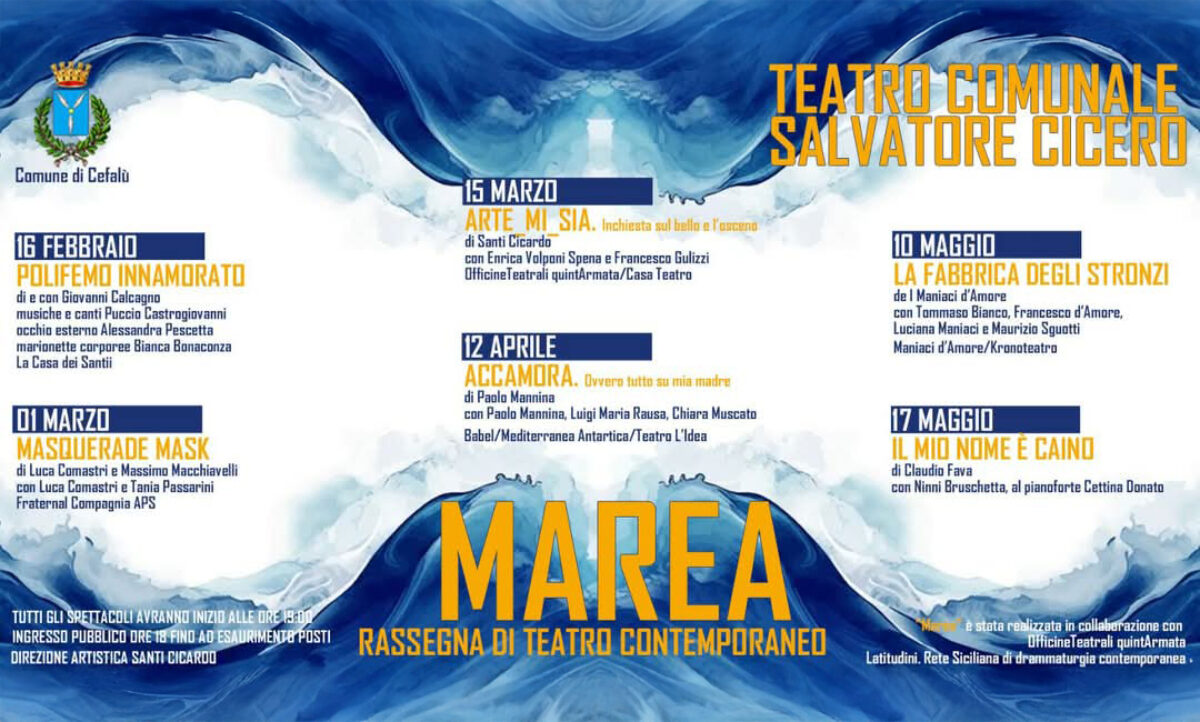
It is time for “Marea” in Cefalù, the free-admission theatre season promoted by the Municipality of Cefalù.
The shows, hosted at the Cicero municipal theatre, are under the artistic direction of Santi Cicardo.
Here is the programme:
The season opens on 16 February at 7 pm with “Polifemo innamorato”, written by and starring Giovanni Calcagno, with music and songs by Puccio Castrogiovanni and outside eye Alessandra Pescetta. A mythical tale lived by characters who come back to life in the body-puppets of Bianca Bonaconza. The narration is interwoven with the dance of young dancers. On 1 March Luca Comastri, Massimo Macchiavelli, Tania Passarini and Fraternal Compagnia Aps will land on stage with “Masquerade Mask”. The show is a tribute to all the characters of Italy’s traditional theatrical culture: from the old Venetian merchant Pantalone to the servants, from the Doctor to the Captains, nobles and lovers. With their pranks and their wit, the characters tackle fundamental social themes: the power of love, the love of power, the hunger and misery of the less fortunate, and magic, which is essential to changing their lives for the better.
The third date is Saturday 15 March with “Arte_Mi_Sia. Inchiesta sul bello e l’osceno” by Santi Cicardo, with Enrica Volponi Spena and Francesco Gulizzi, Officine Teatrali quintArmata/Casa Teatro, video and sound environments by Leonardo Bruno, prop masters Manuela D’Amico and Francesco Gulizzi. It is 14 May 1612, and half of Rome rushes into the sinister halls of the Inquisition for the long-awaited day of judgement on the complaint lodged with Pope Paul V by the father of Artemisia Gentileschi, a young and brilliant artist. In the damp, dark hall of Tor di Nona, the words of Orazio Gentileschi echo in everyone’s mind: “Agostino Tassi deflowered my daughter Artemisia and forced her into repeated carnal acts, harmful to me too, Orazio Gentileschi, painter and citizen of Rome, a poor plaintiff, so much so that I could not earn the rightful income from her talent as a painter”. In a setting reminiscent of a recording studio, two actors study and retrace the key stages of the painter’s story, ending up identifying with the characters they discover in the pages of the trial records.
On 12 April it is the turn of “Accamora. Ovvero tutto su mia madre”, by Paolo Mannina, with Paolo Mannina, Luigi Maria Rausa, Chiara Muscato, Babel/Mediterranea Antartica/Teatro L’Idea. “Accamora” tells of the paradoxical and at times surreal dynamics of a Sicilian family held together by the stubborn love of a widowed woman neglected by her children, who lives amid memories of a time lost and never found again. At the centre of the play is a Mediterranean mother, in this case Sicilian, but she could be Spanish or Tunisian, Greek or Arab, the archetype of all mothers: mother nature, mother-father, mother tongue, mother food, mother culture; and her children: Francesco, an aspiring artist constantly running away from her; and Aurora, eternally engaged and with a secret to keep. In the background, the Sicilian provinces where old and new coexist in a precarious balance. An irresistible family dance with a crescendo of comedy and drama in which each character moves on the edge between self and other, past and present, truth and lies, love and disaffection.
The penultimate date is “La Fabbrica degli Stronzi”, on Saturday 10 May, with Tommaso Bianco, Francesco d’Amore, Luciana Maniaci and Maurizio Sguotti, Compagnia Maniaci d’Amore. A show born from the meeting of two young companies, Kronoteatro from Liguria and the Turin-based group Maniaci d’Amore, among the most active on the Italian independent scene. Different from each other but united by a pitiless gaze at reality, the two theatre companies created “La Fabbrica degli Stronzi”. A title that, of course, does not go unnoticed, for a story that takes the audience into a hysterical and petty world made up exclusively of victims. A world where the blame for every suffering, frustration and misfortune is always placed on someone else: and if there is no one responsible, one is invented. With livid humour and the odd glimmer of tenderness, the show explores three scenes: the couple, the family and the group. The very contemporary taste for recognising oneself not in those who act, but in those who suffer, that is, the popular contest over who burns most in the hell that is other people. This is what could be called the “victim paradigm”, so deeply rooted today in psychoanalysis, in the media, in the family, in our way of inhabiting the world. Four actors tackle a turnover of characters, bringing to life unhappy, angry men and women who cannot put a name to their frustration. They therefore blame mothers, fathers, partners, but also the neighbours across the way, colleagues, fellow tram passengers, dog owners who never pick up the mess. The universe is clearly conspiring to make their lives bitter. What keeps them standing is their very sense of having been wronged and offended. The suspended, surreal style of Maniaci d’Amore thus meets the abrasive, bitter style of Kronoteatro, in an original work that marks an interesting chapter in the new Italian theatre scene.
The season closes with Ninni Bruschetta in “Il mio nome è Caino”, by Claudio Fava. Who is Cain? The archetypal name of all betrayals and acts of violence, the first murderer consecrated by history as the embodiment of absolute violence, Cain is evil. Or, today, Cain could be anyone, one of us, to whom the “trade” of killer has fallen, by destiny or by choice. Claudio Fava tries to give a voice to this Cain of our time, a ruthless mafia hitman. Without justification or repentance. Giving voice and body to Cain is Ninni Bruschetta, loved by the general public for his vivid presence in cinema and on TV, and at the same time a highly refined and incisive stage actor. With Bruschetta, the protagonist of this tale reveals himself as a man faithful to himself and to his destiny, until he senses that somewhere in the city there is Abel, the Other, waiting for him so that the sacrifice may be fulfilled. Accompanying Ninni Bruschetta on stage is composer and conductor Cettina Donato at the piano, with a lively musical presence that supports, improvises, accompanies, drives and urges Cain to tell his story and tell himself.
“Together with Cosa porta il vento – says Mayor Daniele Tumminello – with Marea we are making another season available to the city. A way of making the cultural offering of the Cicero theatre even more plural, aiming to showcase contemporary theatre and enriching the programme funded by the municipal administration”.
All shows start at 7 pm. “Marea” was produced in collaboration with Officine Teatrali quintArmata and Latitudini – Rete Siciliana di drammaturgia contemporanea.